Part 4: Historic Custer,
Idaho
Part of our two week
motorcycle adventure in Idaho (mostly)
September 2016
DRAFT
Introduction and Part 1: Hell's Canyon
drive from Oxbow Bridge along the Snake River to the Hell's Canyon
dam and then back over Oxbow dam to Cambridge, Idaho, and everything
up to Part 2
Part 2: Historic Silver City, Idaho
Part 3: Bruneau Dunes State Park, City of
Rocks National Reserve, Sawtooth Scenic Byway, Sun Valley and
Ketchum
Thursday, Day 6
We were now in the Salmon-Challis National Forest
in Idaho, headed to Sunbeam and the turnoff for historic Custer
ghost town. The turnoff for Custer is about 13 miles North of
Stanley on state road 75. We passed the historic Sunbeam bathhouse,
next to the Salmon river. We didn't stop, but we did slow down, just
so I could point out that, mensch, it was stinky! Apparently, there
are user-built hot spring pools down by the river that are exposed
in Summer and submerged in the river at other times. Then we came to
Sunbeam and the sudden turnoff onto Yankee Fork Road in a road
curve. It is a HUGE mistake on the part of the state that there is
no sign on the highway for Custer. It deserves such. Are you
listening, Idaho
State Historical Society or Visit Idaho? We never would
have known it was there had it not been for meeting that other biker
earlier.
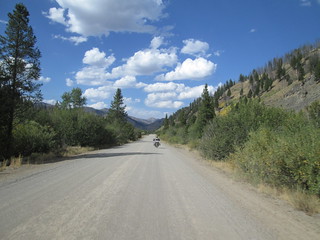 After
the turnoff for Custer, there are two or three national forest
campgrounds on the way to the historic mining town, and they looked
mostly empty. It's just 10 miles from state road 75 to Custer, and
while most of it is gravel, it's the easiest gravel you will ever
do. The wide, well-packed road is atop the rocks dredged out of and
along the Yankee Fork river by gold mining companies and is quite
straight. There were a lot of people camping rough just off the road
- we guessed the campers we saw, all in large RVs, were hunters and
fishermen. We passed a
sign for Bonanza City and passed the Historic
Yankee Fort Gold Dredge, intending to visit both the next day.
It was nearing 5 p.m., and we wanted to get to Custer before then,
in case the information office there closed at 5.
After
the turnoff for Custer, there are two or three national forest
campgrounds on the way to the historic mining town, and they looked
mostly empty. It's just 10 miles from state road 75 to Custer, and
while most of it is gravel, it's the easiest gravel you will ever
do. The wide, well-packed road is atop the rocks dredged out of and
along the Yankee Fork river by gold mining companies and is quite
straight. There were a lot of people camping rough just off the road
- we guessed the campers we saw, all in large RVs, were hunters and
fishermen. We passed a
sign for Bonanza City and passed the Historic
Yankee Fort Gold Dredge, intending to visit both the next day.
It was nearing 5 p.m., and we wanted to get to Custer before then,
in case the information office there closed at 5.
We pulled into Custer and I was immediately delighted. It has far
fewer buildings than Bodie, California or Silver
City, Idaho, but still has lots to see. We parked and walked
into the little one-room museum, which used to be the town's school
house. It was still open, and the man working the front desk was
enthusiastic to answer any questions we might have. We had a look at
the items on display. I was pleased to see the Chinese contributions
to the area so well acknowledged in the museum.
There was a national forest ranger leaving the Empire Saloon across
the street - it's no longer a saloon but, rather, a gift shop and
place to buy soft drinks. She confirmed what Brian had told us, that
there was a campground beyond the town, Custer #1. "And the bathroom
is clean, because I cleaned it this morning!" We pushed on, and the
road was a little more complicated, then a little more
complicated: not as well packed, narrower, and some elevation
changes, but still manageable. We passed the Custer
graveyard, intending to visit the next day. Right after the
sign for Slaughterhouse Gulch, on a curve, on the left, was the
entry for Custer
#1 campsite, and it, the road got significantly steeper, so I
whipped into the campground, making the complicated left turn on a
hill better than I would have if I'd been able to think about it.
Turning into an actual camp site proved more complicated, so I
stopped on the campsite road and waited for Stefan to pick a site,
park, and then come back and park my bike for me. Yeah, I know, some
of you are rolling your eyes. You know what? Screw you. Years ago,
when I was just getting started with motorcycle travel, a woman
motorcyclist in a parking lot in Jordan Valley told me never to be
ashamed of asking someone to help me park, get started, etc.,
because sometimes, some people need help, and that's that. And 30
minutes later, in that very same parking lot, Stefan and I were
helping a guy on his way to Alaska put his way-too-over-packed bike
upright from the kickstand, because he couldn't do it himself.
Of course, I found out later the campsite road is a loop, and I
could have just continued on, turned around, and slipped right into
our campsite... and our
campsite was, we think, the very same one Brian stayed in the
night before - it still had a booking slip on the campsite sign. I
thought I smelled smoke, but we didn't see anything. What we did
see: bees. They were everywhere. They were all over our motorcycles,
and all around us because we were eating - eating some of the
delicious homegrown tomatoes we'd brought from home. We had to hang
our trash up on a nail (already in a tree!) well away from the
picnic table, because the bees just would not go away. I proposed we
stay at the campsite two nights, and see all that there was to see
in the area, but after studying the maps and what we wanted to do,
we realized it wasn't possible. I realized that we were never going
to get to stay two nights somewhere, and that was disappointing,
because that one day off of riding, of just being in one place and
not having to put the tent up and set up camp, is awesome, like a
vacation from our vacation.
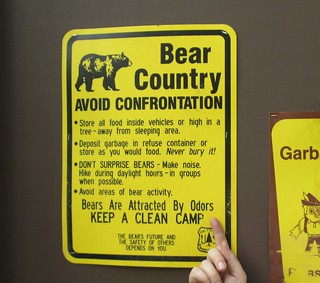 It
cooled off, the bees disappeared at last, and we realized we were
probably going to be alone in the campground that night. We put all
food, the trash and my toiletry bag in our panniers, and the big
food and fuel bag in the pit toilet, because there was a
bears-in-the-area sign on a message board in the campground. I went
to bed and Stefan stood outside smoking after nightfall, and he
said, "I see three sets of glowing eyes staring at me down by the
bathroom." Gulp. He'd heard the critters up on a hill next to the
road, and now they were looking back at him - he had a headlamp on.
He said all were low to the ground. Coyotes? Racoons? I said, "Talk
loudly and tell them to go away. Make a big strong move towards
them." He did. They didn't move. Gulp. Then they finally padded off.
Yeah, going to the bathroom in the middle of the night that night
was a TERRIFIC experience...
It
cooled off, the bees disappeared at last, and we realized we were
probably going to be alone in the campground that night. We put all
food, the trash and my toiletry bag in our panniers, and the big
food and fuel bag in the pit toilet, because there was a
bears-in-the-area sign on a message board in the campground. I went
to bed and Stefan stood outside smoking after nightfall, and he
said, "I see three sets of glowing eyes staring at me down by the
bathroom." Gulp. He'd heard the critters up on a hill next to the
road, and now they were looking back at him - he had a headlamp on.
He said all were low to the ground. Coyotes? Racoons? I said, "Talk
loudly and tell them to go away. Make a big strong move towards
them." He did. They didn't move. Gulp. Then they finally padded off.
Yeah, going to the bathroom in the middle of the night that night
was a TERRIFIC experience...
Friday, Day 7
We got up super early the next day - to a very smokey landscape.
Remember how I smelled smoke the night before? We were nervous - was
the fire just on the other side of the hill? We ate breakfast,
enjoying more of our delicious homegrown tomatoes, but nervously
watching all the high horizons. The forest ranger knew we were
there, so if we needed to evacuate, we expected someone would have
already been there to tell us to get out. The smoke never got worse,
so while we didn't dawdle, we didn't rush.
There was no signs of coyotes or raccoons, that we could find, but a
dear or elk definitely came through and checked out the picnic
table. We were out of the campsite by 9:30 a.m. Mountain time, the
earliest we'd ever pushed off. We stopped at the Custer cemetery.
Cemeteries don't make me sad, just introspective. I ponder... it's
not a very big cemetery, because most people were buried in Bonanza
City. The
most interesting grave is Colonel Sprague's. Further down the
road is a
ranch that seems to have buildings from the Custer era, but we
surmised that it was private property, so we didn't trespass. A
shame the smoke ruined any chance of getting a good photo of the old
mining structure on the side of the a hill on the way down.
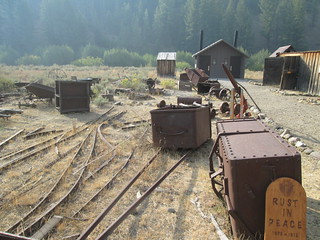 We
arrived in Custer and weren't the first tourists there for the day,
which was a shock. All of the buildings were already open and ready
for visitors. There were far more buildings open for tours than I
expected. Like Bodie, Custer
has lots of items scattered around the site, inside buildings and
outside, rusting. Plenty of stoves
- always my favorite. Lots of mining equipment, fire
fighting equipment, old sewing machines (like this
one that looks like the one my great-grandmother, Mama Susie, had),
an old
bathtub, and
on and on. There are also information boards all around,
providing some interesting
stories about the former residents.
We
arrived in Custer and weren't the first tourists there for the day,
which was a shock. All of the buildings were already open and ready
for visitors. There were far more buildings open for tours than I
expected. Like Bodie, Custer
has lots of items scattered around the site, inside buildings and
outside, rusting. Plenty of stoves
- always my favorite. Lots of mining equipment, fire
fighting equipment, old sewing machines (like this
one that looks like the one my great-grandmother, Mama Susie, had),
an old
bathtub, and
on and on. There are also information boards all around,
providing some interesting
stories about the former residents.
Some
of the photos we took have a mystical feel because of the smoke in
the air, which we learned was from a fire quite far away.
Custer was founded in early 1879 by gold speculators. Custer's
Chinatown, with about thirty residents, was situated right below the
lower end of Custer. The town reached its peak population of 600 in
1896. In its heyday, the town boasted a post office, a school, a
general store, a boarding house, the Nevada House Hotel, restaurants
and saloons. However, it never had a church, something I find
amazing. Another park ranger told us that there was a secret
speakeasy behind one of the buildings. In a town like this, isn't
that a shed with some crates to sit on and a still? By 1910, there
were only about 12 families living in Custer, and when the Sunbeam
Mine closed in April 1911, Custer quickly became a ghost town. It's
been lovingly restored by the Yankee Fork Historical Association,
the Idaho Department of Parks and Recreation and the Salmon-Challis
National Forest.
One of my favorite stories about Custer is about Louise Treloar
Short, who grew up in North Carolina from a well-to-do-family. At
age 30, unmarried, she traveled to join her brothers who worked in
Bayhorse, Idaho. There, she met a man and moved with him to Custer.
He left her in poverty, and she lived along in a tiny, one-room
stone house on a hill above the city - the remains of the house are
still there. Another story is the most famous story from the town,
about three little girls killed in an avalanche in their home. The
three are buried in the town instead of Bonanza, right
behind the school house. There's another story, about a woman
married multiple times, who was murdered in the town - the
storyboard is in the saloon/gift shop, but I forgot to take a photo
of it.
By the way: here's
my favorite stove. I love old stoves.
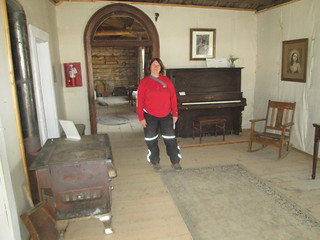 I
wasn't
dressed appropriately for the parlor in the nicest house in town.
And note that, indeed, there is a STOVE in this photo. I think I
took photos of six stoves in the town.
I
wasn't
dressed appropriately for the parlor in the nicest house in town.
And note that, indeed, there is a STOVE in this photo. I think I
took photos of six stoves in the town.
It was a terrific visit. Why do I love visiting historic towns in
the American West? It's hard to say. Sure, they aren't as old or
historic as historic towns in, say, Europe. But there is something
about being a little closer to the past history of my country,
seeing cans and bottles and tools I saw in my great-grandparents'
houses, thinking about the massive changes in human lives in just
100 - 150 years... it really moves me. I also love the
simplicity and practicality in architecture and tools. I like the
thought of valuing live music and good food and visits with friends
that people had then - and rarely have now. I don't romanticize the
lives or the people: they lived hard, most people died young, many
were riddled with physical problems their entire lives, and they
were as cruel as they were noble. And, yet... it makes me just a
little dreamy.
Where would I put this in the ranks of "ghost towns"/historic
mining towns/pre-1900s towns in the USA I've visited? Bodie,
Calfornia remains number 1 - there's just SO much to see, its
history is oh-so-interesting, and the landscape is incredible. Silver City, Idaho is now in the number 2
spot. Custer, Idaho is tied with Garnet, Montana for me at number 3
- and interesting note, the volunteers we met staffing things in
Custer are related to the family that used to own Garnet. If I could
explore Nevada City, Montana more, it might move up in the rankings.
I think Berlin, Nevada is worth visiting - there's not a great deal
there, but there's enough to be interesting, the surroundings give
you a real feeling of the loneliness of a Gold Rush miner's life,
and the Berlin-Ichthyosaur
State Park exhibit of Ichthyosaur bones is right next door.
Columbia, California is worth visiting, but it's just a bit too
touristy for me - though all the restaurants and services and shops
and kitsch is just what other tourists are looking for, so, no
criticism on that count - and I did enjoy my visit there.
On the way out of Custer, the same way we came in, we stopped at the
Historic
Yankee Fort Gold Dredge, for photos outside. We'd decided not
to stop inside after all. Here's the official web site for the
historic dredge. We headed on to Bonanza City, but at
the cemetery, the ground turned to powder dirt, something I
cannot ride on. I parked and toured the cemetery while Stefan pushed
on to see if there was much to see in Bonanza City. If there was, he
never found it, just a
nice view from the road.
However, we could have left and headed to Challis by going back on
the road we took to Custer #1 campground, past the Custer cematery:
this is the 46-mile dirt and gravel Custer Motorway that follows the
route of the original 1879 toll road that lead to Custer from
Challis. You can call the Land of the Yankee Fork Visitor Center for
current status of the road (snow, or no?). It is not recommended for
low clearance vehicles or trailers. I refused to go on it because
the incline just past the campground was SUPER steep, and I couldn't
imagine going on a a 46 mile road like that on a fully loaded-down
bike, even a KLR, at least not at my skill level.
We headed back out to paved State Road 75, heading to Challis.
More in Part 5:
- Ft. Missoula, Montana
- Wallace, Idaho
- Lake Coeur d'Alene, Idaho
- White Pine Scenic Byway, Idaho
- Hell's Canyon Overlook, Oregon
- Joseph, Oregon
- Painted Hills, Oregon
- Little Crater Lake, Oregon
Know when I travel by:
Following me me at My
@jayne_a_broad Twitter
feed 
This Twitter feed is focused on my experiences traveling, camping,
riding my motorcycle or my bicycle, taking mass transit (buses and
trains), commuting by walking or bicycling, and various other
mostly-personal interests.
Liking my Jayne A
Broad Facebook page 
This Facebook fan page is where I follow USA state parks, national
parks, national forests, and organizations focused on sustainable
tourism, getting children, women and under-represented groups
outdoors, and related international organizations and sites. My
travel-related tweets from the my jayne_a_broad twitter feed
(see below) get posted here automatically.
Return to the broads abroad home
page
Disclaimer
Any activity incurs risk. The author assumes no responsibility for
the use of information contained within this document.
A Broad Abroad | contact me
The content of this page
is by by Jayne Cravens, 2006-2016, all rights reserved