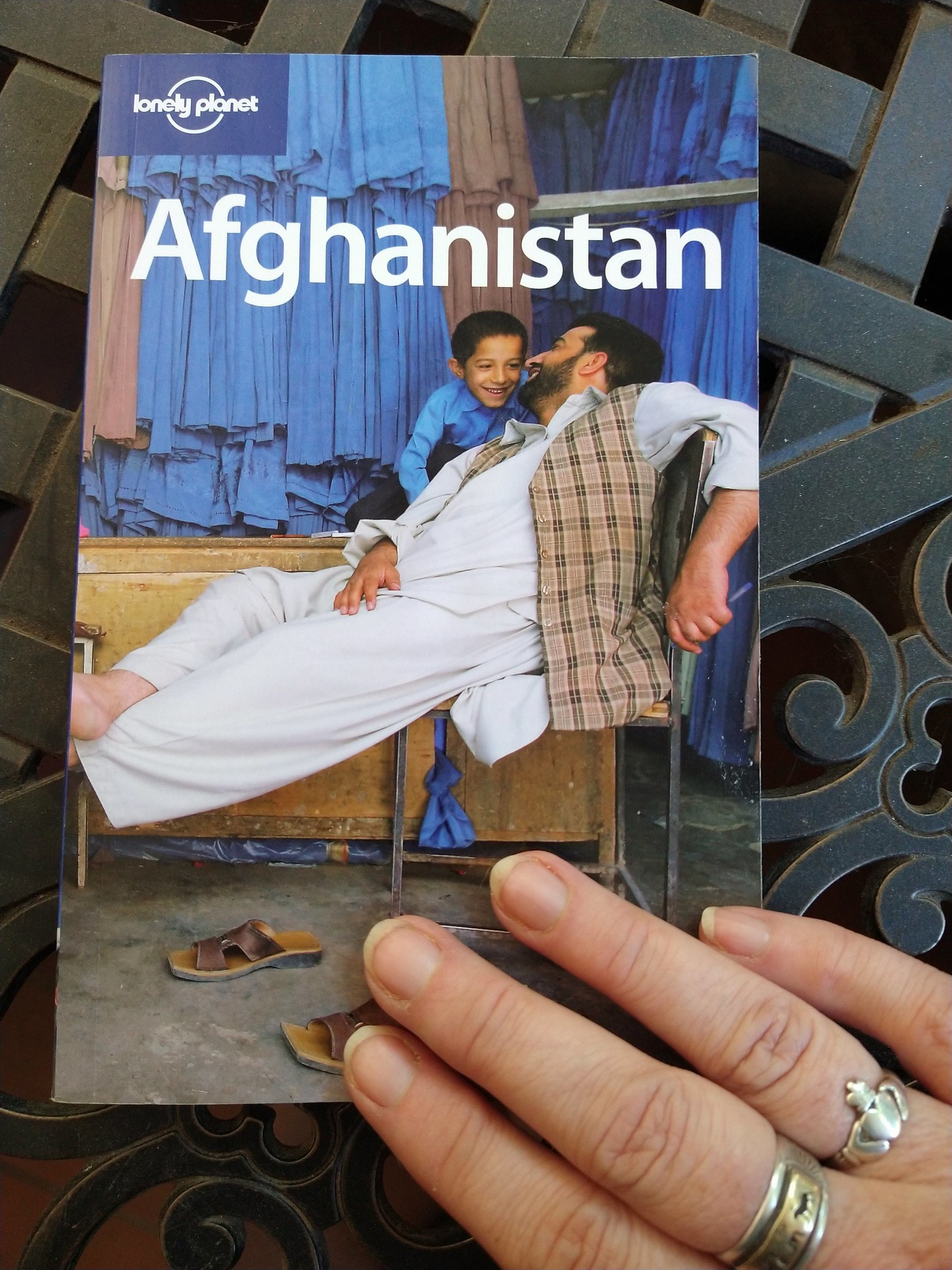
When I left Afghanistan in August of 2007 as a UN staff member, I fully expected to return as a tourist within a year. Why wouldn’t I? Things were looking up! Lonely Planet had already published a guide to the country. I would come back with my husband, see all my Afghan colleagues at the Afghan government agency where I’d had worked for six months, return to Afghan Fried Chicken, have brunch at the Serena, revisit the National Museum in Kabul, bring more English books to my carpet-selling friend, etc., and then we would go up to Bamyan, which had a burgeoning tourist infrastructure, with tour guides and guest houses. Maybe we’d make it to Herat as well!
None of that happened. A year later, the security situation was far worse – and just kept getting worse. UN workers weren’t living in guest houses and working onsite at government and NGO offices anymore – they had to live and work and even shop in a deeply fortified compound, all together. The two-hour safety training I’d had – just a group of us in a room with a slide show – had become an intense, immersive training on how to survive a kidnapping. And the situation just kept getting worse.
14 years later, Afghanistan fell to the Taliban, and I spent my days and nights at my computer here in Oregon, crying and trying desperately to get colleagues out and removing photos online of Afghan women and girls I had worked with.
I still work to try to help Afghan women, like this one who is pretty much imprisoned in her home, by herself. I’m still in touch with a few people in Kabul, and I read accounts from UNDP, Amnesty International, Tolo News and Rukhshana Media regularly, so I know what’s happening with Afghan women, specifically.
I think every day of all those professional women I worked with, and their daughters. I think of once upon a time talking to them about their work and their dreams for their family, their daughters especially. All gone. I think of the Hazara woman who cleaned my guest house, who ran to me down the hall when I had returned from Germany, grabbing my hands and jumping up and down that I was back. Where is she? Is she alive? Does she have a home?
Now, a lot of foreigners, particularly from Europe, North America, Australia and Asia, including women, are going to Afghanistan as tourists. They’ a’re having a lovely time. They go to historic sites, they go to outdoor markets, they go to some of the few remaining restaurants, they even walk on the streets. Some even pose for photos with the Taliban, the terrorists now in charge of the country. These tourists sometimes even say things like, “I was treated so well! I don’t understand what all the fuss is about!” and “I saw some women! I think things are fine.”
I have begged tourists not to go to Afghanistan. Because to go to Afghanistan as a tourist is to support the Taliban. To go to Afghanistan and show its beauty and wonder – and Afghanistan is beautiful and wondrous – and never mention the horrific oppression of women and girls is to participate in their horrific oppression. Nothing but lovely scenery says, “Everything is fine here.” And that silence about the condition of women means approval.
A travel influencer from a European country, whom I have followed for years on YouTube, went to Saudi Arabia, and I was deeply troubled. Saudi Arabia funded the attacks in the USA on September 11, 2001, and a majority of the hijackers were Saudi Arabian nationals. They have never been held accountable for that. The government of Saudi Arabia ordered and orchestrated the torture and murder of Jamal Khashoggi. They have never been held accountable for that. While rights for women have steadily improved over the past decade, Saudi Arabia remains near the bottom of the World Economic Forum’s Global Gender Index, coming 132nd out of 148 countries in the 2025 report. Women legally need the permission of a male guardian to marry or divorce, and married women are required by law to obey their husband, resulting in untold numbers living in abusive relationships. Women are imprisoned for YEARS for sharing opinions supporting women’s rights on social media. All of that is why I won’t go. But the status of women has dramatically improved in the last few years in Saudi Arabia, many women from Saudi Arabia are endorsing foreign travel there, and for some women (not me), that’s enough for the country to be “rewarded” with a visit.
A few months later, this same travel influencer went to Afghanistan.
I cried when I realized she was going. I couldn’t believe she would put her channel and pursuit of “likes” ahead of the women of Afghanistan.
As she traveled to the border in Pakistan, she did go into detail about the restrictions for Afghan women. And she said she hoped that her presence and actions in the country gave the Taliban pause about what they were doing and about the strength of women. I appreciated that. But once in the country, she’s been silent about the plight of women. And as she edits her videos and publishes them long after she’s been to a place, she would be perfectly safe in putting in reminders in videos for her followers about the status of women in Afghanistan.
But she has been silent. I’m sure she would make a little speech about “I don’t like to get political” and every country has issues and blah blah blah if pressed. But the reality remains the same: silence means approval. And to go to Afghanistan and not speak out about the condition of women there, a place where women horrifically, systematically excluded, oppressed and abused, to post “Look at me!” doing incredible things but never mention that Afghan women cannot do any of that, to never mention what Afghan women are going through, is the same as going to Nazi Germany or Apartheid South Africa and focusing on the tourist sites and food.
I posted the following to her channel comments. I doubt it will remain. Or if it does, I’m sure there will be plenty of replies about how I need to lighten up. I don’t care. And I know that I won’t be seeking out an opportunity to meet her – I have no interest now. I’m just horrified I’m the only one saying this:
Half of the people of Afghanistan are forbidden from attending school, from going to work, from going anywhere without a male family member as escort, from doing anything you see in this video. They are the women and girls of Afghanistan, and it is forbidden for their voices to be heard outside of their homes – even if they are in their homes. Foreign women, particularly from the West, enjoy the privilege of traveling to and through Afghanistan, on their own, and touring historic sites – while local women are, for the most part, hidden away. Please don’t assume that all is well for women and girls in Afghanistan because of travel influencer videos – it is, in fact, horrific, and there are hundreds of accounts attesting to this. Please don’t assume because you have seen five or six women in this video that the women and girls of Afghanistan have any freedom at all. Please think carefully about traveling to Afghanistan, and think carefully about the message you will be sending with the videos you share about your experience there, and most of all, please learn more and be an ally to Afghan women and girls and use your privilege to speak out whenever you can on their behalf:
- Amnesty International: https://www.amnestyusa.org/reports/shadow-brief-the-human-rights-situation-of-women-and-girls-in-afghanistan/
- Rukhshana Media: https://rukhshana.com/en/
- What it’s like to be a woman in Afghanistan in 2025 – from UN Women. https://www.unwomen.org/en/articles/faqs/faqs-afghanistan
- Malala Fund: https://malala.org/countries/afghanistan
I’ll never give up on you, women and girls of Afghanistan. I’m not much… I’ll just keep doing what I can, little that it is.
October 16, 2025 update:
I have not identified the travel influencer I was referring to, mostly because while I am disappointed in what she’s done, and not done, I don’t want her to be a target of a hate campaign.
12 hours after I posted the comment on her YouTube channel, this post by her showed up on her Instagram account:
🇦🇫 Every single day I am aware of the fact that I am riding here alone as a woman. Something that local Afghan women are not allowed to. Every time I start to relax, I turn around the corner and run into Taliban. Some are friendly, others are not. I was hoping to be able to speak to many women here, but this is turning out harder than I thought. I don’t see many of them, and often they wear full face coverings, making eye contact and a first connection impossible.
I’d prefer she say a LOT more, but maybe she’s realizing that her Afghan videos are NOT looking like she’s an ally to Afghan women AT ALL.
In addition, today, I found out that the New Yorker has reported on the rise of “Talibro” alt-travel videos. The following is adapted from a post on the New Yorker’s Facebook page:
Three hostages kneel in front of a camera, their hands tied behind their backs and their heads covered with black plastic bags that obscure their faces. Looming behind them is a group of glowering militants, some holding assault rifles. “We have one message for America,” the man standing in the middle says. To people who grew up in the 2000s, this scene is immediately recognizable—it was all eerily reminiscent of the beheading videos of Daniel Pearl and James Foley.
But this video takes a different turn. The speaker removes the bag from the face of the man kneeling before him, who then proceeds to flash a Hollywood smile and give an emphatic thumbs-up. “Welcome to Afghanistan!” he says straight into the camera, after which a montage of Westerners posing for pictures in mountain glens and doing pullups on the barrels of tank guns starts to play.
Two American travel influencers created the video as a provocative advertisement for their travel company as well as an encouragement for tourists to visit the Taliban-controlled country. The two men are part of a growing crop of alt-travel influencers who have dipped into contrarianism and conspiracy theories—and followed the rightward shift of their young male audiences. Several other content creators have spent time travelling through Afghanistan, glowingly sharing stories about how men can still be men, given the Taliban’s preservation of traditional values. They also take videos and make speeches to imply that the Western media has exaggerated the plight of women in Afghanistan to embarrass and isolate the Taliban, and that Afghan women, in fact, “have it pretty good.”
If you have not read a New Yorker article in several months, you can access the entire article for free. Otherwise, it is behind a paywall.
And now, I have to go throw up.









Leave a Reply to mary wolcott barnes Cancel reply