Whenever a disaster strikes, thousands of people start contacting
various organizations and posting to online groups in an effort to
try to volunteer onsite at the disaster site. Some even jump in
their cars and drive to an affected area they have heard about in
the news, or start gathering what they think affected people might
need. Some even FLY to the area, even in another country, and
announce, "Hey, here I am, ready to help!"
But what most of these people don't realize is that
spontaneous volunteers without specific training and no
affiliation can actually cause more problems than they alleviate
in a disaster situation. Consider this:
- In many post-disaster situations, there is NO food,
shelter, services or gas to spare for volunteers. Many
volunteers going into the Philippines, Pakistan, Haiti, Japan,
even the Gulf Coast states in the USA after Katrina or states
affected by Sandy, had to be absolutely self-sustaining for
many, many days, even many weeks. No shelter or safety
measures could be provided to these volunteers by the
government. Those volunteers who weren't self-sustaining
created big problems.
- Just because you have some equipment does not mean you are
ready to volunteer: inexperienced people have been killed
using chain saws after hurricanes and other disasters, by
falling limbs and live electrical wires, during their DIY
clean up efforts. Responding to these people when they get
themselves into a jam takes away from the needs of local
people.
- In disaster situations, you are going to be encountering
disaster victims. They are going to be stressed, maybe
desperate, and maybe angry. As a trained volunteer or paid
staff member working with a credible organization, you are
going to know how to comfort these people and direct them to
where they can get assistance, and how to convince them that
you have to save this person over here instead of their
relative over there. You need to know how to not re-traumatize
them with questions or comments. If you are untrained and
unaffiliated, you may become a target of their anger, because
you cannot provide them with appropriate assistance, or
because you provide them with incorrect
information.
- In many disaster situations, volunteers must be mentally
and physically prepared to work 16 hour days (or more) in highly-stressful
situations where their own basic needs (like going to the
bathroom) must be kept to a minimum. They may have to live in
austere conditions, sleeping in a tent (that they must bring
themselves) or a gymnasium with dozens, even hundreds, of
other people, and using a very rustic latrine. And what
happens if you get to the situation and discover you cannot
handle what's happening around you, such as a riot, or a
medical situation, or an armed group that shows up to rob you,
or an illness of your own? Volunteers who show up,
unaffiliated, untrained and not self-sufficient get in the
way rather than helping, and take precious resources from
those who have been devastated in a disaster situation.
- Spontaneous volunteers also may not familiar with the
concepts of situation assessments, incident management or
chain of command. These three skills are essential in disaster
situations, to ensure that resources get where they are needed
as quickly as possible, rescues and relief efforts go to the
most needed, efforts aren't duplicated in one area while
another area has absolutely nothing, etc. They must understand
cultural and legal boundaries, and accept supervision. Gaining
these skills comes from previous training with a credible
organization specifically regarding disaster response.
- What will you do when you are accused of stealing from
someone? Of harming someone? Of making a situation worse? What
do you know about local customs and cultural taboos that, if
you violate them, could taint all outside volunteer efforts?
Abroad, aid workers have been arrested, even killed, because
of cultural missteps. Who will navigate local bureaucracies in
a foreign countries to save YOU in such situations?
- There's also a problem with people showing up at disaster
sites under the guise of wanting to volunteer, but who are
actually there to take advantage of unattended houses and
shops, or even to exploit disaster victims, taking what few
resources they may have and even harming them physically. To
ensure the safety of victims, disaster organizations need
volunteers who have already been screened and trained -- two
things that can't be done during the disaster itself but,
rather, need to have been done months earlier.
- Duplication of efforts can get out-of-control during
disaster response. I've seen many people online saying they
are creating an instant volunteer matching service to get
people who want to help connected with people who need help,
not realizing that there are already volunteer
matching services and that volunteers with no training,
interacting with mentally or emotionally-unstable people can
lead to not-so-nice outcomes.
- Note that many of the aforementioned warnings are
applicable to the home quarantines that resulted from COVID-19
- epidemics and pandemics are also disasters, and careful
volunteer responses are also necessary, because many home
bound people are vulnerable, being targeted by people claiming
to be volunteers but aren't, etc.
- In traveling to other countries, volunteers need visas and
documents that affirm their expertise. You can't simply show
up at the border and announce that you are a doctor, for
instance. The government does not have time to determine if
you are who you say you are.
Even wildlife rehabilitation and clean up requires people with
proper training and experience -- not just people with good
hearts. People have harmed wildlife instead of helping them in
their DIY efforts to respond to disasters.
Consider this advice from the
From National Voluntary Organizations Active in Disaster
(USA):
Seeing images of disaster may compel you to head to the
impacted area. Don’t underestimate the complexity of working in
a disaster area. Until a need has been identified and the local
community impacted has requested support, volunteers should not
enter.
- Be
sure to affiliate with existing voluntary organization
before coming to the disaster area, and that organization
has been asked to respond.
- Wait
until it is safe to travel to volunteer sites and
opportunities have been identified.
- Once
assigned a position, make sure you have been given an
assignment and are wearing proper safety gear for the
task.
Recovery lasts a lot longer than the media attention. There
will be volunteer needs for many months, often years, after the
disaster – especially when the community enters the long-term
recovery period.
Disasters are incredibly complicated situations that
require people with a very high degree of qualifications and
long-term commitment, not just good will, a sense of urgency
and short-term availability.
Also, more and more agencies are hiring local people, even
immediately after a disaster, to clean rubble, remove dead
bodies, build temporary housing, rebuild homes and essential
buildings, and prepare and distribute food. Hiring local people
to do these activities, rather than bringing people in from the
outside, helps stabilize local people's lives much more quickly!
The priority in post-disaster situations is helping the
people affected by the disaster, NOT giving spontaneous,
unaffiliated volunteers an outlet for their desire to help.
Heard about DYI
volunteer efforts in Haiti?? My blog talks about when
DIY efforts work and how, usually, it's still a bad idea.
When does it work? When the DIY volunteers have been to the
country before, have established relationships with local
agencies or local community leaders, have coordinated efforts in
the country previously, and have many, many years of experience
in post-conflict or post-disaster situations.
People outside of disaster zones also want to start gathering
supplies from family, neighbors and co-workers, envisioning
themselves packing up the boxes of supplies and some
organization somewhere paying to ship those boxes to
post-disaster zones. But it is so much cheaper and more
efficient for response agencies to buy and ship these items from
areas that are MUCH closer to an affected area that most (all?)
agencies refuse these items. It's also better for relief
agencies to buy clothing, shoes, medicine, toiletries, etc. new,
or to accept donations in bulk directly from manufacturers and
retailers, rather than going through donations made by countless
numbers of individuals, which are filled with inappropriate
items (expired food and medicine, clothes that aren't clean or
aren't culturally-appropriate, broken items, etc.).
If you have been moved by a disaster to help in some way
immediately, please consider donating financially to the
American Red Cross (you can identify the local chapter in or
nearest a disaster area if you want to give directly - this is
very easy to do online): money is usually desperately needed to
purchase and transport food, up-to-date medicine, and create
shelter, as well as to employ local people so that they can
recover as quickly as possible. Animals are often the forgotten
victims in disasters - dogs, cats, other pets, horses and other
livestock are often left behind after a disaster, or become
lost, or aren't allowed in a human shelter, and many face
starvation or death from injuries - so also look online for
local humane societies, local ASPCAs, and other animal shelters
and animal welfare agencies, as they are immediately desperate
for help after disaster situations. In addition to giving funds
yourself, you can help by making sure friends and associates
know how to give (you might be surprised how many people don't
know where or how to). A simple link on your own site or blog, a
link at the end of your emails, an update on your status on FaceBook
or whatever, telling people how to donate financially, can be a
huge help.
Also, please do NOT start gathering food, clothing, medicine,
toys, furniture or whatever for those affected in a disaster
zone. DO NOT DO THIS. Unless you have called an organization in
an affected area (a homeless shelter, an animal shelter, a
hotel, whatever) and spoken to someone who told you EXACTLY what
they need, by what date, and you have arranged transportation to
get it there (do NOT expect the organization to come pick it
up!), do NOT gather items to send to a disaster area. Here's
more about Donating
Things Instead of Cash or Time (In-Kind Contributions).
Also see How to Make a Difference
Internationally/Globally/in Another Country Without
Going Abroad
And see this page with advice on Creating
or Holding a Successful Fund Raising Event.
|
|
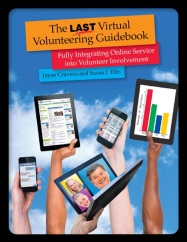 The
Last Virtual Volunteering Guidebook available
for purchase as a paperback & an ebook The
Last Virtual Volunteering Guidebook available
for purchase as a paperback & an ebook
This book is for both organizations new to virtual volunteering,
as well as for organizations already involving online volunteers
who want to improve or expand their programs. The last chapter
of the book is especially for online volunteers themselves.
Another book recommendation:
Lonely
Planet Volunteer: A Traveller's Guide to Making a Difference
Around
|